The Living Room That Swallowed America: How Home Became the Only Place We Go
When Fun Had an Address
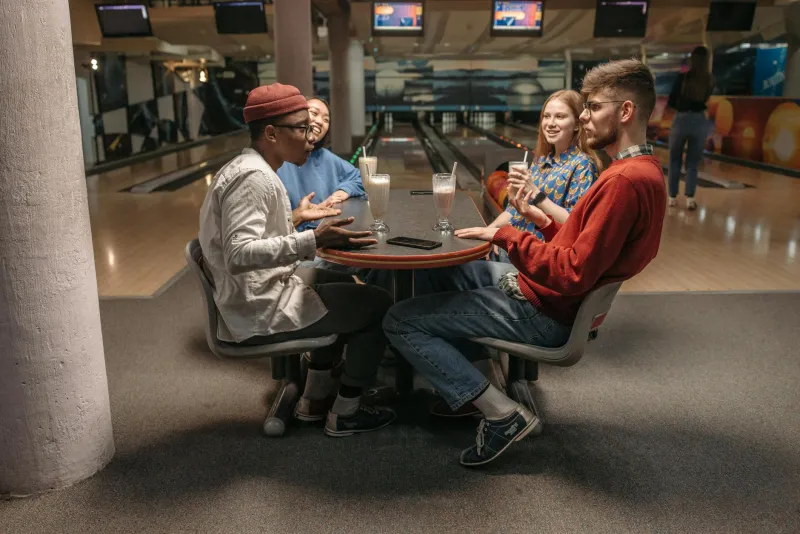
In 1970, if you wanted to be entertained, you had to put on shoes and leave the house. Entertainment wasn't something that came to you—it was somewhere you went. The local bowling alley hummed with the crash of pins and the chatter of league nights. Roller rinks pulsed with disco lights and the rhythmic whoosh of wheels on hardwood. Movie theaters weren't just screens in strip malls; they were ornate palaces with velvet curtains, balconies, and ushers who actually ushered.
Americans didn't just consume entertainment—they gathered around it. The arcade was a social ecosystem where teenagers fed quarters into Pac-Man machines and challenged strangers to Street Fighter. The dance hall was where couples met, not where they watched other people dance on TikTok. Even something as simple as listening to music often meant going somewhere: the record store, where you could sample albums in listening booths, or live venues where bands played to rooms full of people who had nowhere else to hear them.
The Great Indoor Migration
Something fundamental shifted in the 1980s and '90s. Home entertainment technology didn't just improve—it exploded. The VCR meant you could watch movies without driving to the theater. Cable television offered dozens of channels instead of three networks. Video game consoles brought the arcade experience into the living room, minus the sticky floors and other people's cigarette smoke.
Each innovation solved a real problem. Why deal with crowded theaters when you could pause the movie for bathroom breaks? Why coordinate with friends for bowling night when you could play video games whenever you wanted? Why get dressed up for dinner when delivery could bring restaurant food to your couch?
The convenience was undeniable. But convenience has a way of becoming compulsion. What started as an option—stay in tonight instead of going out—gradually became the default. Going out required increasingly compelling reasons to overcome the inertia of staying in.
The Architecture of Isolation
By the 2010s, American homes had transformed into entertainment fortresses. Living rooms sprouted massive flat-screen TVs that dwarfed the modest sets of previous decades. Home theater systems delivered surround sound that rivaled actual theaters. High-speed internet brought infinite content libraries, video games with photorealistic graphics, and social media platforms that promised connection without leaving your ZIP code.
The COVID-19 pandemic accelerated trends that were already decades in the making. Suddenly, everything came to your door: groceries, restaurant meals, retail shopping, even cocktails mixed by professional bartenders. Streaming services added thousands of new titles. Video conferencing replaced in-person meetings. The outside world became optional in ways that would have been unimaginable to previous generations.
What We Built vs. What We Lost
Today's home entertainment ecosystem is undeniably superior in many ways. You can watch any movie ever made, play games with people across the globe, and order food from restaurants you'd never drive to. The quality is better, the selection is infinite, and the cost per hour of entertainment has plummeted.
But something intangible disappeared in the translation from public to private entertainment. The bowling alley wasn't just about knocking down pins—it was about the ritual of changing into rental shoes, the particular acoustics of a room designed for one purpose, the way strangers became temporary teammates when someone bowled a strike in the next lane.
Movie palaces weren't just bigger screens—they were shared experiences where audiences gasped, laughed, and applauded together. The collective intake of breath during a horror movie or the spontaneous applause after an action sequence created moments that couldn't be replicated on a couch, no matter how large the TV.
Even the inefficiencies of going out served a purpose. The drive to the roller rink built anticipation. Waiting in line for concert tickets created a sense of investment in the experience. The ritual of getting ready to go somewhere—choosing an outfit, meeting friends, traveling together—was part of the entertainment, not an obstacle to it.
The Social Infrastructure We Dismantled
The shift toward home entertainment didn't just change how Americans have fun—it quietly dismantled the social infrastructure that brought communities together. The local movie theater wasn't just a business; it was a gathering place where neighbors encountered each other regularly. Bowling leagues created weekly social obligations that crossed class and age lines. Dance halls and roller rinks gave teenagers somewhere to go that wasn't school or home.
These weren't perfect institutions. Many excluded people based on race, class, or other factors. But they created what sociologists call "weak ties"—casual connections between people who might not otherwise interact. The person you nodded to at the bowling alley, the couple you recognized from the movie theater, the teenager who always dominated the arcade's high score list—these peripheral relationships formed the connective tissue of community life.
The Drift Toward Isolation
Today's entertainment landscape offers unprecedented choice and convenience, but it's fundamentally designed for individual consumption. Even social media, which promises connection, often delivers a curated version of social interaction that can be turned on and off at will. You can play video games with friends online, but you'll never bump into them unexpectedly while getting popcorn.
The bedroom—or more accurately, the entire home—became America's entertainment destination by solving real problems with going out: crowds, inconvenience, expense, and unpredictability. But in solving those problems, we may have created new ones. The art of shared public experience, the serendipity of unplanned encounters, and the simple habit of leaving the house for fun have become increasingly rare skills.
We gained control over our entertainment, but we lost something harder to quantify: the particular kind of community that forms when people gather regularly in the same physical spaces, pursuing the same simple pleasures, week after week, year after year.