The Sound of Spoons on Plates
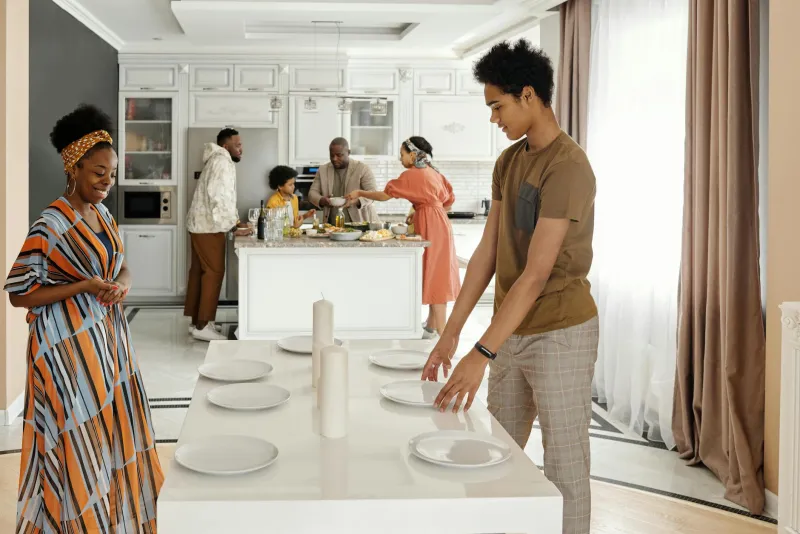
At exactly 6 PM, across millions of American homes, the same scene played out every weeknight: families gathering around kitchen tables, passing serving bowls, and talking about their days. It wasn't planned or scheduled—it just happened, as naturally as sunrise.
The dinner table was command central for American family life. Homework got discussed, weekend plans were made, and family news was shared over pot roast and mashed potatoes. Parents learned about their kids' friends, teachers, and daily dramas. Children absorbed adult conversation about work, neighbors, and the wider world.
This wasn't a special occasion. It was Tuesday.
The Architecture of Togetherness
Mid-century American homes were designed around the assumption that families ate together. Kitchen tables sat prominently in the center of the house, surrounded by chairs that matched and stayed in place. Dining rooms weren't showpieces—they were the Sunday version of the everyday ritual.
Meal preparation reflected this commitment to shared eating. Mothers (and it was almost always mothers) planned menus around family schedules, cooking meals that could be ready precisely when everyone gathered. The evening routine was choreographed: Dad home by 5:30, kids washed up, everyone seated by 6.
Even the food was designed for sharing. Casseroles, roasts, and family-style sides that required passing and serving. The act of eating was inherently collaborative—someone had to carve the chicken, someone else ladled the vegetables, and everyone waited for grace or for Dad to start before digging in.
The Numbers Tell the Story
In 1960, 85% of American families with children ate dinner together five or more nights per week. By 1980, that number had dropped to 65%. Today, it hovers around 30%.
The decline wasn't gradual—it accelerated dramatically starting in the 1990s. Between 1995 and 2010, the percentage of families eating together most nights of the week dropped by nearly half.
Meanwhile, the average American family dinner shrunk from 45 minutes in 1960 to just 18 minutes today. We're not just eating together less often—when we do gather, we're rushing through it.
The Great Scattering
The family dinner didn't die from a single cause—it was killed by a thousand small changes that made shared meals increasingly difficult to coordinate.
Children's schedules exploded. Soccer practice, piano lessons, tutoring, and youth group meetings scattered kids across town every evening. The idea that everyone could be home by 6 PM became laughably unrealistic for families juggling multiple activities.
Parental work schedules became less predictable. Longer commutes, evening meetings, and the rise of dual-career households made the reliable 5:30 homecoming a thing of the past. When both parents work until 6 or 7 PM, family dinner becomes a logistical impossibility.
Food preparation changed too. The rise of fast food, takeout, and microwave meals meant families could eat quickly and individually rather than waiting for someone to cook a proper meal that required sitting down together.
The Microwave Revolution
Perhaps no single appliance did more to kill the family dinner than the microwave oven. Introduced widely in the 1970s, microwaves made it possible for family members to eat different foods at different times with minimal preparation.
Sudenly, dinner could be whenever you were hungry, whatever you wanted to eat, wherever you happened to be. The tyranny of the shared meal time was broken. Freedom felt great—until families realized they'd stopped talking to each other.
The rise of individual portion sizes paralleled this shift. TV dinners, Hot Pockets, and single-serving everything meant you didn't need to coordinate with anyone else to eat. The family-sized casserole gave way to personal pizzas and individual yogurt cups.
Screen Time vs. Face Time
Television dealt the first blow to dinner conversation, but smartphones and tablets delivered the killing stroke. Today's family dinners—when they happen—often feature everyone staring at their own device while mechanically consuming food.
The average American checks their phone 96 times per day. During the typical 18-minute family dinner, that's at least three interruptions per person. Conversation becomes impossible when everyone's attention is divided between the table and their screen.
Social media created a cruel irony: families stopped talking to each other in person but started sharing photos of their meals online. We document our food more than we discuss our lives.
What Research Says We Lost
Studies consistently show that children who grew up with regular family dinners perform better academically, have lower rates of depression and anxiety, and are less likely to engage in risky behaviors like drug use or early sexual activity.
But the benefits weren't just for kids. Parents who regularly shared family meals reported feeling more connected to their children and more confident in their parenting. The dinner table served as an early warning system for family problems—changes in appetite, mood, or behavior were immediately visible when everyone gathered daily.
Family dinners also transmitted cultural knowledge in ways that formal education couldn't replicate. Children learned table manners, conversation skills, and family history through daily practice. Stories about grandparents, family traditions, and cultural values were passed down between the salad course and dessert.
The COVID Paradox
Interestingly, the 2020 pandemic temporarily reversed decades of decline in family dining. With restaurants closed and everyone home, many families rediscovered the pleasure of eating together. Grocery sales of family-style foods surged, and surveys showed increased family meal frequency across all demographics.
But as life returned to normal, most families quickly reverted to their pre-pandemic eating patterns. The brief return to family dinners highlighted what we'd lost without providing a sustainable path back.
The New Dinner Table
Today's families that do prioritize shared meals often have to be incredibly intentional about it. They schedule dinner like any other appointment, turn off all devices, and treat the meal as sacred time.
Some families have adapted by moving the shared meal to breakfast or weekend brunches when schedules are more flexible. Others have embraced "family snack time" or regular coffee dates as substitutes for the traditional dinner gathering.
Restaurants have tried to fill the gap with "family-style" dining and communal tables, but eating out can't replicate the intimacy and routine of home-cooked meals around your own table.
The Drift Toward Solitude
The decline of family dinner represents a broader shift toward individualized living. We've optimized for personal convenience and choice at the expense of shared experience and connection.
This change happened gradually enough that most families didn't notice until it was complete. One day you're eating together every night, and the next day you realize it's been months since everyone was home at the same time for a meal.
The family dinner table, once the gravitational center of American domestic life, became just another piece of furniture—a place to sort mail, do homework, or eat while scrolling through your phone.
Somewhere in that drift, we lost one of humanity's oldest rituals: the simple act of sharing food and conversation at the end of each day. We gained efficiency and lost connection, traded convenience for community, and discovered that a family can live under the same roof while barely sharing the same life.
The table is still there. The chairs are still there. But the ritual that once brought American families together every evening at six o'clock sharp has quietly slipped away, leaving behind only the furniture and the fading memory of what it felt like when everyone actually showed up.