When Your Pharmacist Knew Your Medical History Better Than Your Doctor
When Your Pharmacist Knew Your Medical History Better Than Your Doctor
Walk into any CVS or Walgreens today, and you'll find yourself in a fluorescent-lit maze of vitamins, greeting cards, and impulse buys. The pharmacy counter sits in the back like an afterthought, staffed by rotating faces behind bulletproof glass. You scan a barcode, swipe a card, and walk away with a white bag full of pills you hope are correct.
Fifty years ago, picking up medication was an entirely different experience.
The Corner Drugstore That Knew Everyone
In 1970, most Americans got their prescriptions filled at independent neighborhood pharmacies. These weren't just retail outlets—they were community institutions run by pharmacists who'd often inherited the business from their fathers or worked the same corner for decades.
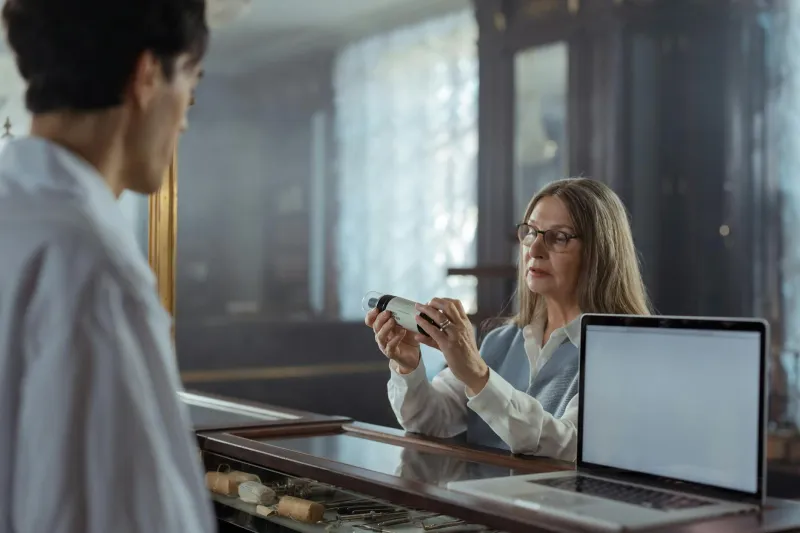
Charlie Morrison ran Morrison's Pharmacy in downtown Springfield for thirty-seven years. He knew that Mrs. Henderson's blood pressure medication made her dizzy if she took it with her morning coffee. He remembered that young Tommy Chen had an allergic reaction to penicillin when he was eight. When Dr. Williams prescribed a new arthritis medication for Frank Kowalski, Charlie would call the doctor's office if he noticed it might interact with Frank's heart pills.
This wasn't exceptional service—it was just how pharmacies worked.
More Than Just Pill Counting
The neighborhood pharmacist served as an informal healthcare advisor, bridging the gap between doctors' visits. They'd explain why you needed to take antibiotics with food, warn you about drowsiness from allergy medication, and suggest over-the-counter alternatives that might work just as well for minor ailments.
Many pharmacists kept detailed handwritten records of every customer's prescription history. They'd notice patterns—maybe your asthma got worse every spring, or your blood pressure medication needed adjusting during stressful periods. Some would even call to check how you were feeling after starting a new prescription.
The relationship was deeply personal. Pharmacists often knew three generations of the same family. They'd remember that your grandmother couldn't swallow large pills and would special-order smaller versions. They knew which customers were struggling financially and might quietly suggest generic alternatives or payment plans.
The Rise of Chain Efficiency
By the 1980s, chain pharmacies began dominating the landscape. CVS, founded in 1963, grew from a handful of stores to over 1,000 locations by 1985. Walgreens expanded from a regional Midwest chain to a national powerhouse. These companies promised convenience, longer hours, and lower prices.
The trade-off was the loss of personal relationships. Chain pharmacies operated on efficiency models designed to process high volumes of prescriptions quickly. Pharmacists became interchangeable employees who might work at different locations throughout the week. The focus shifted from consultation to transaction speed.
Computer systems replaced handwritten prescription records. While this improved accuracy and made prescription histories portable, it also meant that the human knowledge—the understanding of how medications actually affected individual patients—got lost in the digital transition.
Today's Pharmaceutical Landscape
Modern pharmacy operations prioritize speed and cost-effectiveness. Drive-through windows, automated dispensing systems, and mail-order prescriptions have made getting medication more convenient but far less personal. Many prescriptions are filled by pharmacy technicians rather than licensed pharmacists, with minimal patient interaction.
The average chain pharmacy fills over 300 prescriptions per day, compared to maybe 50-75 at a typical independent pharmacy in the 1970s. Pharmacists today spend most of their time verifying prescriptions and managing insurance claims rather than counseling patients.
Meanwhile, Americans take more medications than ever before. The average person over 65 takes four prescription drugs daily, often prescribed by different doctors who may not communicate with each other. Without a pharmacist who knows your complete medical picture, dangerous interactions become more likely.
What We Lost Along the Way
The disappearance of the neighborhood pharmacist represents more than just changing retail patterns—it's part of the broader transformation of healthcare from relationship-based to transaction-based care. The pharmacist who knew your family's medical history, who'd call your doctor with concerns, who'd notice if you seemed confused about dosing instructions—that person served as a crucial safety net.
Today's patients navigate complex medication regimens largely on their own. They rely on internet searches, prescription labels, and their own memory to manage drug interactions and side effects. The institutional knowledge that once protected communities has been replaced by individual responsibility.
The Human Cost of Efficiency
While modern pharmacies offer undeniable conveniences—24-hour service, insurance integration, and vast inventories—they've also created new problems. Medication errors are more common when pharmacists don't know their patients personally. Dangerous drug interactions slip through automated systems that can't account for over-the-counter medications or herbal supplements that patients don't report.
The elderly are particularly affected by this shift. Many grew up trusting their pharmacist as a healthcare advisor and struggle to adapt to the impersonal nature of modern pharmacy chains. They're more likely to have questions about their medications but less likely to receive meaningful answers from overworked staff.
A Different Kind of Progress
The evolution of American pharmacy reflects our broader cultural shift toward efficiency and convenience over relationships and community knowledge. We've gained speed, scale, and standardization. But we've also lost something harder to quantify—the reassurance of having a healthcare professional who knew our history, understood our concerns, and took personal responsibility for our wellbeing.
In chasing pharmaceutical efficiency, we may have forgotten that the best medication management isn't just about getting the right pills in the right bottles. Sometimes it's about having someone who knows that those pills make you dizzy, and cares enough to remember.