The Chair That Built Community
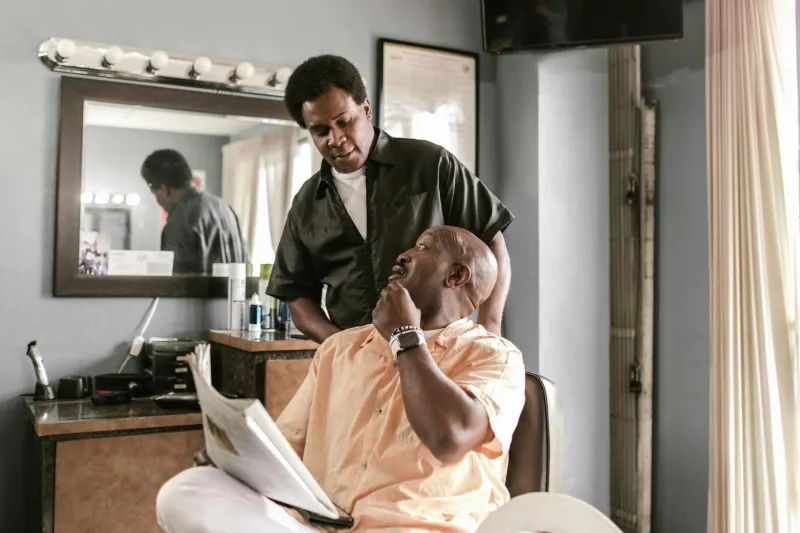
Every Saturday morning in 1965, Frank's Barbershop on Maple Street hummed with conversation. Three chairs, five waiting customers, and the kind of unhurried debate that could stretch a twenty-minute haircut into an hour-long social event. Men discussed everything from the Yankees' chances to Vietnam, from local politics to whose kid made the honor roll. The barbershop wasn't just where you got your hair cut—it was where you caught up on life.
 Photo: Maple Street, via images.squarespace-cdn.com
Today, that same corner houses a Great Clips. Twelve chairs, no waiting, and conversations limited to "How would you like it cut?" The efficiency is remarkable. The silence is deafening.
Democracy in a Barber Chair
The traditional barbershop operated on a simple principle: everyone was equal in the chair. Whether you were the bank president or the guy who swept floors at the factory, you waited your turn and joined the conversation. Politics got heated, sports got passionate, and community issues got thoroughly dissected by men who actually lived in the neighborhood.
Barbers weren't just skilled with scissors—they were unofficial mayors of their four walls. They knew who was looking for work, whose marriage was struggling, which kid needed a talking-to. The barbershop served as an informal information exchange where news traveled faster than the local paper could print it.
"You didn't go to Frank's just for a haircut," remembers Tony Martinez, now 78, who grew up getting trimmed at the same shop his father visited. "You went to find out what was happening in town. Frank knew everything and everybody."
The Ritual of Slowing Down
The old barbershop demanded patience. Hot towels, straight razor shaves, and conversations that meandered like Sunday drives. Men learned to sit still, to listen, to engage with people they might not otherwise encounter. The experience taught a form of social interaction that today's world has largely abandoned.
Waiting wasn't inconvenience—it was opportunity. Fathers brought sons, creating generational bridges. Strangers became neighbors through shared commentary on local high school football. The barbershop fostered the kind of casual civic engagement that political scientists now desperately try to recreate through community forums and town halls.
Efficiency Killed the Experience
The transformation didn't happen overnight. Suburban sprawl scattered tight-knit neighborhoods. Strip mall salons offered cheaper cuts and longer hours. Women entered the workforce en masse, changing household routines. Men began cutting their own hair or visiting unisex chains where conversation was discouraged in favor of turnover.
Modern barbershops—the ones that survive—often cater to nostalgia rather than community. They feature vintage chairs and old-timey signage, but the customers scroll phones instead of talking politics. The aesthetic remains while the essence has vanished.
"Everything's faster now, more convenient," says Mike Chen, who owns one of the few traditional barbershops left in his Ohio town. "But guys come in, get their cut, and leave. Nobody lingers anymore. Nobody really talks."
What We Lost When We Stopped Gathering
The death of the neighborhood barbershop represents something larger than changing grooming habits. It signals the end of what sociologist Ray Oldenburg called "third places"—spaces that aren't home or work where people naturally congregate and build social bonds.
Men, particularly, lost a crucial venue for connection. Unlike women, who more easily maintain friendships through various social channels, men often relied on structured environments like barbershops for meaningful interaction beyond family and colleagues. The casual intimacy of regular Saturday morning conversations provided emotional outlet and community connection that many men now struggle to find.
Research shows that American men report fewer close friendships than previous generations. The decline of institutions like neighborhood barbershops—along with union halls, corner taverns, and local clubs—has left many men socially isolated despite being more digitally connected than ever.
The Algorithm Can't Replace the Barber
Social media promised to connect us, but it lacks the democratic mixing that made barbershops special. Online, we choose our echo chambers. In Frank's chair, you heard perspectives you might not seek out but needed to encounter. The barber's chair was a great equalizer in ways that LinkedIn and Facebook will never match.
Today's men get their news from curated feeds, their social interaction from group texts, their sense of community from online forums. It's efficient, personalized, and completely lacking the messy, unpredictable human element that made Saturday morning at the barbershop an education in democracy.
When Convenience Costs Community
The modern world offers unprecedented convenience—mobile barbers, at-home hair clippers, and salon apps that eliminate waiting. But in optimizing for efficiency, we've eliminated the very inefficiencies that built community. The waiting, the talking, the unhurried pace of neighborhood life—these weren't bugs in the system. They were features.
Every Great Clips represents progress: faster service, lower prices, consistent quality. But each one also represents loss: the end of a gathering place, the death of casual civic engagement, the disappearance of spaces where men learned to be neighbors instead of just customers.
The barbershop's decline mirrors America's broader shift from community-centered to convenience-centered living. We gained efficiency and lost something harder to measure but perhaps more valuable—the simple act of showing up somewhere regularly and becoming part of something larger than ourselves.