The Card Catalog Taught You Something the Search Bar Never Will
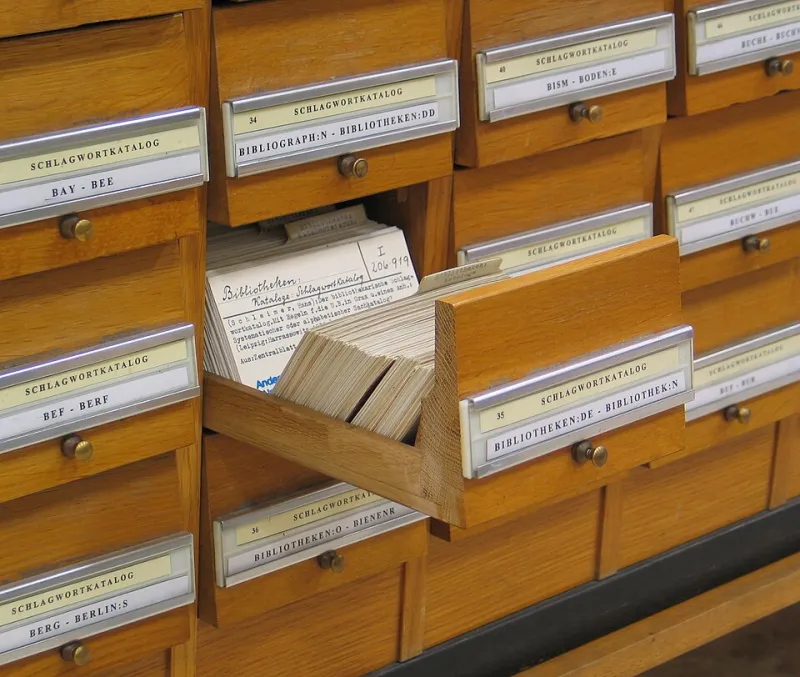
Photo: Dr. Marcus Gossler, CC BY-SA 3.0, via Wikimedia Commons
There was a specific kind of frustration that doesn't really exist anymore. You'd spend forty-five minutes at the library working through a research assignment, find exactly the book you needed in the card catalog, track down the call number, navigate the stacks — and discover the book was already checked out. Checked out by someone else, for reasons you'd never know, for a return date that might be three weeks away.
You had to figure out what to do next.
That moment — the small crisis of a missing resource, the need to improvise — was doing more educational work than most people gave it credit for. It was teaching you something that no search engine has ever had to teach anyone: that information has limits, and navigating those limits requires judgment.
The Research Process Was the Assignment
For most of the twentieth century, a school research paper was, in practice, two assignments rolled into one. The first was the visible assignment: write five pages on the causes of World War I, or explain the water cycle, or argue a position on a historical event. The second was invisible but equally demanding: go find the information yourself.
That second assignment required a set of skills that had to be developed through use. You needed to know how a library was organized. You needed to understand the difference between a primary and secondary source before a teacher ever formally defined those terms for you, because you'd had the experience of holding a newspaper from 1943 and recognizing instinctively that it was different from a textbook written in 1978.
You had to talk to a librarian. This was, for many kids, genuinely uncomfortable. You had to articulate what you were looking for to another person, accept their suggestions, follow a path you hadn't anticipated. The librarian might redirect you to a reference section you didn't know existed. They might suggest an angle on your topic you hadn't considered. That conversation was an education in itself — in how knowledge is organized, in how experts navigate complexity, in how to ask a better question.
Scarcity as a Thinking Tool
Here's the counterintuitive part: the limitations of the pre-internet research process were pedagogically valuable in ways that only became clear once they were gone.
When you had access to three books on a topic instead of three thousand articles, you read those books carefully. You took notes by hand, which forced you to paraphrase, which forced you to understand. You couldn't copy a passage directly into your paper without the labor of retyping it, which created a natural friction that slowed down the worst impulses of academic shortcuts.
More importantly, you had to evaluate your sources because you couldn't find enough of them. If one of your three books was from 1952 and another was from 1989, you had to think about what might have changed in the scholarship between those dates. If two sources contradicted each other, you couldn't just find a third that agreed with the one you preferred — you had to sit with the contradiction and try to reason through it.
That reasoning process — slow, uncertain, requiring actual thought — is what researchers and educators mean when they talk about critical thinking. It wasn't a skill explicitly taught so much as one that emerged from the conditions of the work.
The Moment the Friction Disappeared
The shift happened fast. In the mid-1990s, most American schools still had physical card catalogs and limited computer access. By the early 2000s, the internet had fundamentally changed what a research assignment looked like in practice, even if the assignments themselves hadn't changed yet.
The first thing students discovered was that finding information was no longer the hard part. The hard part became something nobody had quite prepared them for: deciding which of ten thousand results was worth reading. And without the trained judgment that came from years of working with limited sources, many students defaulted to the most convenient answer — the first result, the Wikipedia summary, the passage that could be lightly rearranged and submitted.
Teachers noticed quickly. The vocabulary got more sophisticated — students were using words and phrases they clearly didn't understand because they'd found them online and dropped them in. The arguments got thinner. The citations got stranger. Something about the quality of the thinking had changed, and it wasn't just laziness. It was that the process that had built the thinking was gone.
What Schools Have Been Trying to Get Back
Educators have spent the past two decades attempting to reconstruct, artificially, the conditions that used to exist naturally. Information literacy curricula. Source evaluation frameworks. Explicit lessons on how to tell a credible website from a dubious one. Assignments that prohibit Wikipedia. Research projects that require physical library visits.
These are genuine efforts, and some of them work reasonably well. But there's something slightly melancholy about needing to formally teach skills that used to develop organically from the constraints of the environment. You didn't need a lesson on evaluating sources when you only had four of them and had to make each one count.
The deeper loss may be harder to recover. Pre-internet research was inherently nonlinear. You followed a thread from the card catalog to the stacks to a footnote in a book that led you somewhere unexpected. You discovered things adjacent to what you were looking for. The serendipity of a library — stumbling across a book that changed the direction of your paper entirely — is almost impossible to replicate in a search environment optimized to give you exactly what you asked for.
The Patience That Built the Thinking
Learning to research the old way required patience at every stage. Patience waiting for a book to come off the hold shelf. Patience reading through material that only partially applied to your question. Patience sitting with uncertainty while you figured out what you actually knew and what you still needed to find.
That patience wasn't incidental to the education. It was the education — the slow accumulation of judgment about how knowledge works, where it lives, and how much of it you can trust.
The search bar is faster. There's no question about that. But speed and understanding have never been the same thing, and the drift from one to the other happened so gradually that most people didn't notice what was being traded away.