Dog-Eared Pages and Circled Dreams: The Toy Catalog That Taught Kids How to Want Things

It arrived without fanfare, usually tucked between the utility bill and a coupon circular. But every kid in the house knew what it was the moment it hit the kitchen table. The Sears Wish Book. The JCPenney Christmas catalog. The big, glossy, impossible document that turned November into something worth enduring.
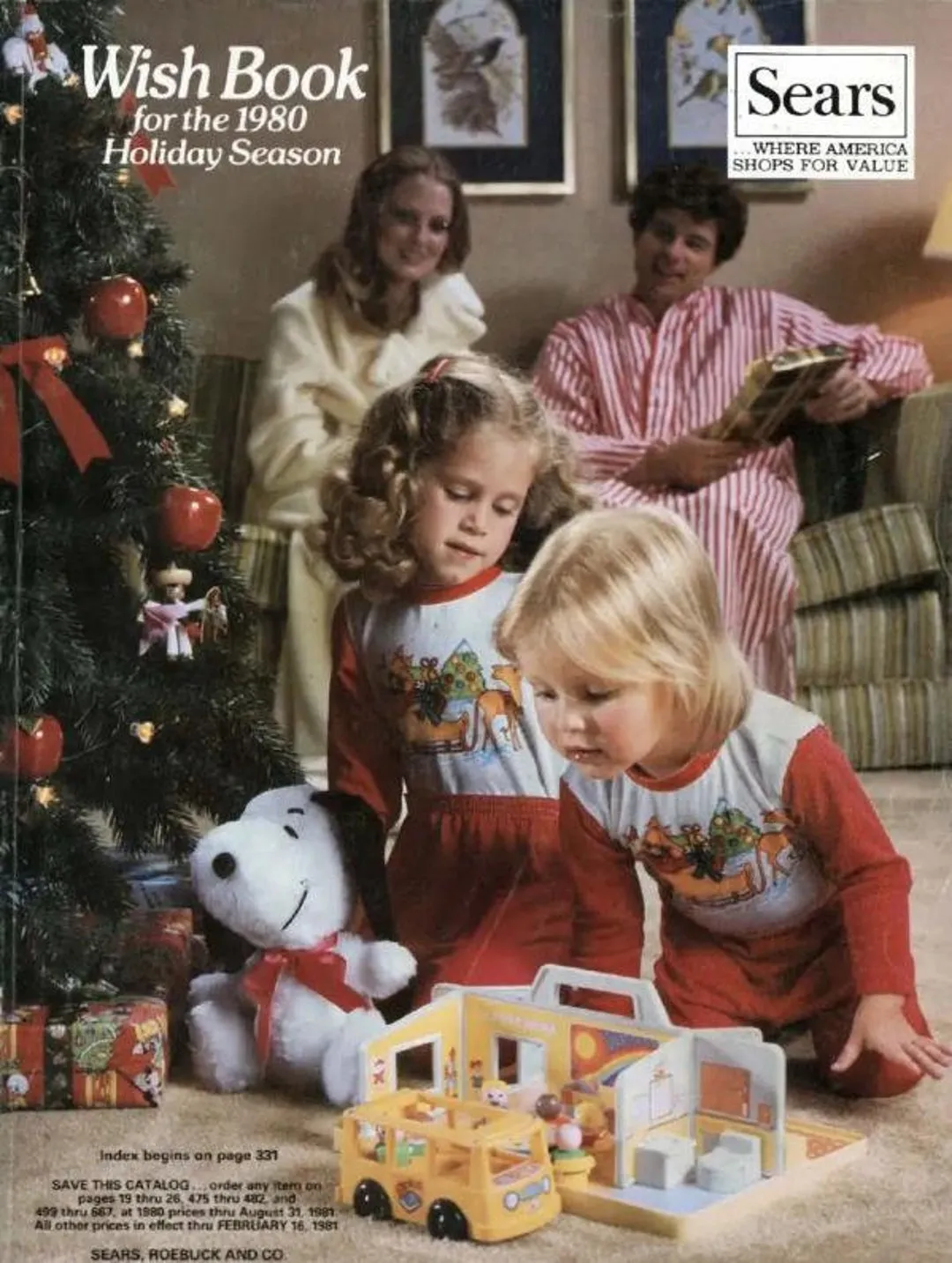 Photo: Sears Wish Book, via i.etsystatic.com
For roughly five decades in American life, the holiday toy catalog was less a retail publication than a cultural institution. And what it quietly taught an entire generation of children about desire, patience, and imagination has never quite been replaced.
The Ritual of the Arrival
The Sears Wish Book launched in 1933, born out of the Great Depression as a way to keep customers dreaming even when they couldn't buy. By the postwar boom years, it had become a fixture of American childhood — a document that arrived with the same reliable weight as the changing of seasons.
At its peak in the 1970s and '80s, the Sears catalog ran to nearly 600 pages. The toy section alone could occupy a child for an entire afternoon. Kids didn't browse it the way adults flipped through a magazine. They studied it. They returned to it over days and weeks. They memorized page numbers. They developed opinions about products they would never own, argued with siblings about the relative merits of competing options, and made and revised their lists with a seriousness that would have impressed any procurement officer.
The dog-eared page became its own language. A turned corner meant serious intent. A pencil circle meant this one, specifically, not the other one. A note in the margin — sometimes barely legible, written in the careful hand of a seven-year-old — meant please.
The Slowness Was the Point
What made the catalog experience so different from anything that exists today wasn't the products. It was the time.
Wanting something from a physical catalog required patience at every stage. You waited for the catalog to arrive. You spent weeks with it before deciding what to ask for. You wrote your list — by hand, usually — and submitted it to whatever parental authority governed these matters. Then you waited through the rest of November and all of December, with no way to check a shipping status or confirm that the item was still available.
That waiting period was not empty. It was full of imagination. A child who had been staring at a particular toy for six weeks had already played with it a hundred times in their mind. They had invented scenarios for it, argued its merits to friends, and built an entire anticipatory relationship with an object they hadn't yet touched. When Christmas morning finally arrived and the thing was actually there — actually real, actually theirs — the gap between wanting and having had been so long and so vivid that the experience carried genuine emotional weight.
Psychologists have a term for this: anticipatory pleasure. The joy of looking forward to something. Research consistently shows that the anticipation of a positive event often generates as much happiness as the event itself — sometimes more. The catalog was, without anyone designing it this way, a masterclass in the emotional architecture of desire.
What One-Click Erased
Amazon launched in 1995. The Sears Wish Book printed its last edition in 1993, two years earlier, as if it could already feel what was coming. By the early 2000s, the idea of waiting weeks to browse a physical publication before deciding what to want had become almost quaint.
Today's version of the wish list is an algorithm. A child who shows interest in one toy is immediately served fifteen related options, ranked by popularity and available for next-day delivery. There's no waiting, no dog-earing, no circling. The gap between wanting and having has been compressed to nearly nothing.
On one level, that's obviously better. More choice, faster delivery, no risk of the item being out of stock on Christmas Eve. But something got left behind in the efficiency.
The modern child who orders something and receives it two days later has had a transaction. The child who spent six weeks with a catalog page, who could describe every feature of a toy they'd never held, who lay awake on Christmas Eve with genuine, almost unbearable anticipation — that child had an experience. The difference between those two things is larger than it sounds.
The Handwritten List
There's one more piece of this that deserves mention, and it's the smallest: the act of writing the list itself.
Every child who grew up in the catalog era remembers sitting down, at some point in December, to produce a handwritten document of their wishes. It required decisions. You couldn't ask for everything — or rather, you could, but even children understood that the list needed some editorial discipline. What did you actually want most? What could you live without? What was worth the space on the page?
Those choices were real. They required self-knowledge and a kind of early negotiation with the limits of the world. A child who wrote a wish list was practicing, in miniature, the adult skill of prioritizing desire against constraint.
Nobody teaches that explicitly. It just happened, every November, for fifty years, because a thick catalog arrived in the mail and a kid sat down with a crayon to decide what mattered.
The Pages Nobody Turns Anymore
The holiday catalog hasn't vanished entirely — a few retailers still produce them, and they've even seen a modest nostalgic revival in recent years. But they're curiosities now, not rituals. The culture of slow wanting that surrounded them is gone.
What replaced it is faster, more efficient, and immeasurably more convenient. It is also, in a way that's hard to articulate but easy to feel, a little bit emptier. The drift from anticipation to instant gratification happened so gradually that most of us didn't notice the thing we were giving up.
Somewhere in a box in a garage, there's probably a 1987 Wish Book with a page bent back to the Transformers section, a red crayon circle around one specific item, and a child's careful handwriting in the margin.
That child knew exactly what they wanted. And they'd been wanting it for weeks.