Nobody Knocked First: The Glorious Chaos of Childhood Before the Playdate
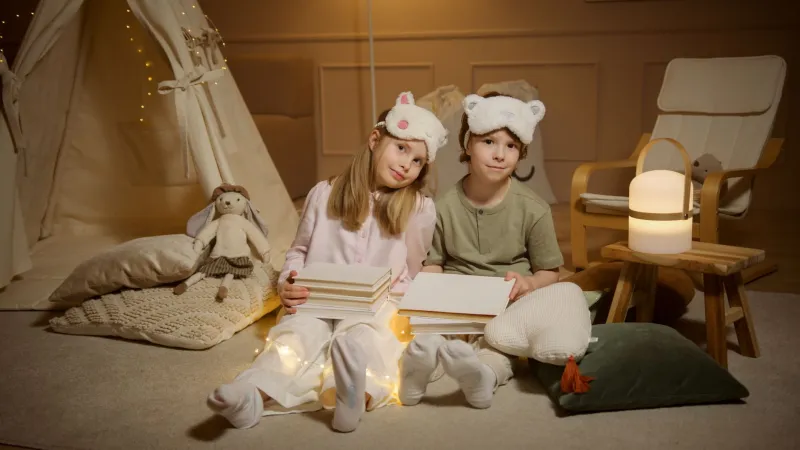
Somewhere around 1983, on a Saturday morning in almost any American suburb, a ten-year-old was still asleep on a friend's living room floor. There was no permission slip for it. Nobody had texted ahead. A sleeping bag had been dragged out of a hall closet, cereal had been poured in the dark after midnight, and by Sunday afternoon the kid would wander home — sunburned, half-fed, and entirely alive.
That world is gone. And most of us didn't notice it leaving.
The Unscheduled Weekend
For most of the 20th century, childhood friendship operated on a kind of beautiful anarchy. Kids in American neighborhoods from the 1940s through the 1980s built their social lives through proximity and improvisation. You knocked on a door. You called up to a window. You showed up at the vacant lot behind the elementary school because that's where everyone always ended up eventually.
Sleepovers happened the same way. They weren't events. They were drift — one afternoon bleeding into an evening, an evening bleeding into a morning, nobody quite tracking the hours. Parents knew roughly where their kids were. Roughly was usually enough.
The freedom wasn't just physical. It was emotional. Kids worked out their own conflicts, negotiated the rules of games nobody had officially invented, and figured out what it meant to spend real, uninterrupted time with another person. Boredom was part of the deal. So was the occasional falling-out, the awkward silence at 2 a.m., the friendship that got stronger because you'd already seen each other at your worst before breakfast.
When Supervision Became the Default
The shift didn't happen all at once. It crept in through a combination of forces that each seemed reasonable on their own.
The 1980s brought a wave of high-profile child abduction cases — many of them amplified far beyond their statistical reality by a 24-hour news cycle that was just learning how to terrify people. Stranger danger became a national curriculum. The idea of kids roaming unsupervised, which had been entirely ordinary for decades, started to feel irresponsible.
At the same time, American parenting culture was shifting toward what sociologists would later call "intensive parenting" — the belief that good parents are present, involved, and actively managing their children's development at all times. Unstructured time started to look like wasted time. Extracurricular schedules expanded. Soccer practice, piano lessons, and travel sports teams filled the calendar slots that used to belong to nobody in particular.
By the 1990s, the playdate had arrived — a scheduled, adult-organized social interaction between children, often with a defined start time, an end time, and at least one supervising parent nearby. It was friendly. It was safe. It was nothing like what it replaced.
What the Sleepover Actually Was
Here's what gets lost in the nostalgia: the sleepover wasn't really about the sleeping. It was about the hours that didn't have a name.
It was the conversation that started at midnight when the lights were out and nobody was performing for anyone. It was the shared experience of being bored together and figuring out what to do about it. It was the trust that built up slowly over dozens of small, unwitnessed moments — the kind of trust that doesn't develop on a two-hour playdate with a parent in the next room.
Child development researchers have spent considerable energy in recent years documenting what unstructured play actually does for kids. It builds conflict resolution skills. It develops autonomy and self-regulation. It creates the kind of deep peer bonds that structured activities rarely replicate. Kids who spend time in loosely supervised, child-directed environments tend to be better at reading social situations and managing their own emotions.
None of that was news to the generation that grew up doing it. They just called it hanging out.
The Screen-Shaped Replacement
Today's version of childhood friendship has a different texture entirely. Kids who might otherwise be wandering the neighborhood are more likely to be in adjacent rooms, each on a separate device, connected through a game or a chat thread. It counts as socializing. In some ways it genuinely is. But it doesn't replicate the particular intimacy of physical presence over an extended, unplanned stretch of time.
The scheduled playdate hasn't disappeared — it's just been joined by the virtual hangout, the shared TikTok feed, the group chat that substitutes for the walk home. Kids are in contact constantly and together rarely. The paradox of modern childhood friendship is that it's both more connected and more managed than anything previous generations experienced.
Meanwhile, the liability culture that helped kill the unscheduled sleepover has only deepened. Parents in some communities have faced legal scrutiny for allowing their children to walk to school alone or play in a park without supervision. The informal networks of neighborhood trust that once made unsupervised childhood possible — the understanding that Mrs. Patterson two doors down was keeping an eye out, that the Garcias would feed whoever showed up at dinner — those networks have largely dissolved along with the neighborhoods that held them.
What the Kids Didn't Know They Were Learning
The children who grew up in those unstructured weekends didn't think of themselves as learning anything. That was the point. They were just living.
But what they were actually doing was practicing the fundamental skills of human relationship: how to be with someone when there's nothing to do, how to recover from an argument without an adult mediating, how to show up for a friend at midnight when things got strange and quiet and honest.
Those aren't skills you can schedule. They emerge in the gaps — in the hours that don't belong to any agenda, in the long, shapeless stretches of time that childhood used to contain in abundance.
Somewhere out there, a sleeping bag is still folded in a hall closet. It hasn't been unrolled in years.