Twenty-Four Exposures and Then You Wait: The Lost Art of Not Knowing How the Photo Turned Out
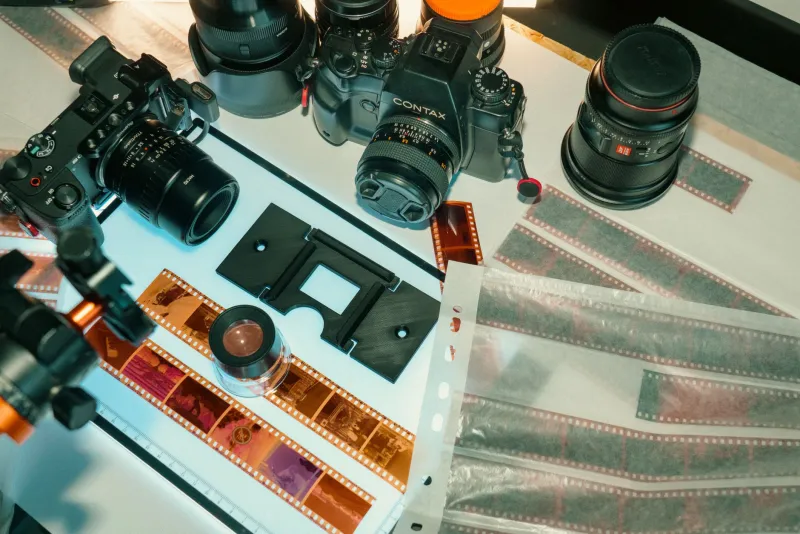
Somewhere in a shoebox in your parents' attic — or your grandparents', or maybe your own — there's probably a stack of photographs with scalloped edges and dates stamped in orange on the back. AUG 1987. JUN 1993. DEC 1979. They're slightly out of focus in some cases. Someone's eyes are closed in another. There's an entire frame that's just a thumb.
And then there's one that's perfect. A kid mid-laugh on a dock. Sunlight coming through the trees at exactly the right angle. A moment so precisely caught that it looks like it was composed, even though the person holding the camera had no idea what they had until weeks later, sitting at the kitchen table with an envelope from the drugstore.
That gap — between the click of the shutter and the moment you actually saw what you'd captured — was one of the defining experiences of photography for most of the twentieth century. It shaped how people thought about moments, about memory, and about what was worth preserving. And it's so thoroughly gone now that most people under thirty have never experienced it at all.
The Roll That Had to Last
A standard roll of 35mm film gave you 24 or 36 exposures. That sounds like a lot until you're at your nephew's birthday party, you've already used fifteen frames on the drive there, and you're trying to decide whether this moment — the kid's face right before he blows out the candles — is worth one of your remaining nine shots.
That's not a constraint most photographers today ever encounter. Modern smartphones don't just allow unlimited images; they actively encourage them. Burst mode captures dozens of frames per second. Storage is effectively infinite. The question is no longer should I take this photo but which of these forty photos of the same moment should I keep.
The scarcity of film wasn't just an inconvenience. It was a forcing function for attention. When you had a limited number of shots, you looked harder. You waited for the right moment instead of shooting continuously and sorting later. You made a decision — a real one, with a cost attached — every time you pressed the shutter.
Photographers who came up shooting film often describe a kind of discipline that's difficult to teach in a digital environment. Not just technical discipline, but perceptual discipline. The habit of actually seeing what's in front of you before you try to record it.
The Six-Week Wait and What It Did to Memory
In the 1970s and into the '80s, getting film developed could take several weeks, especially in smaller towns where rolls had to be mailed to processing labs. Even as one-hour photo services became widespread in the late '80s and '90s, most people still dropped off film and came back the next day or the day after.
That delay between experience and image created something psychologists now find genuinely interesting: it allowed memories to form independently of photographs. You remembered the Fourth of July barbecue through the sensory experience of it — the heat, the smell of charcoal, the sound of the game on someone's radio — before you ever saw a picture of it. The photograph, when it arrived, was a confirmation of a memory you'd already built, not a replacement for it.
Research into memory and photography suggests this distinction matters more than it might seem. When we photograph an experience immediately and review the images immediately, we tend to outsource the memory to the image. The photo becomes the record, and the mental experience fades faster. Psychologists call this the photo-taking impairment effect — the act of photographing something can actually reduce how well you remember it, particularly when you know you can review the image anytime.
The family that waited six weeks to see their vacation photos had already done the work of remembering. The photograph added to the memory rather than replacing it.
The Ritual of the Envelope
Picking up developed photos had a quality that's almost impossible to replicate today. You drove to the drugstore or the photo counter at the grocery store, handed over your claim slip, and received an envelope you hadn't opened yet. The walk back to the car — or sometimes the impatient tearing-open right there at the counter — had genuine suspense attached to it.
You might find that the whole roll was underexposed because you'd loaded the film wrong. You might find one transcendent image you'd completely forgotten taking. You might find evidence of a moment — a candid laugh, an unguarded expression — that nobody had posed for and nobody remembered until right now.
The randomness was part of the experience. Film photography was partly an act of faith: you did your best, you trusted the light and the moment and your own instincts, and then you let go. The results arrived later, on their own schedule, without your intervention.
Digital photography eliminated the faith part. You know immediately. You can adjust and retake. You can delete the ones you don't like before anyone else sees them. The loop between intention and result collapsed to nearly zero, and with it went the particular kind of anticipation that made opening that envelope feel like something.
What Scarcity Gave the Image
There's a reason certain old photographs carry a weight that most digital images don't. Part of it is nostalgia, certainly. But part of it is that the photograph survived a genuine selection process. It existed because someone chose to spend one of their 24 exposures on it, paid to have it developed, and kept it through multiple moves and decades of accumulated stuff.
Every photograph in a shoebox is there because it cleared several bars. The digital photograph on your phone cleared none of them. It exists because storage is free and deletion requires a small effort you never quite got around to.
This isn't an argument against digital photography, which has made image-making accessible to billions of people and preserved moments that would otherwise have been lost entirely. It's an observation about what happens when the cost of capturing something drops to zero: everything gets captured, and nothing gets chosen.
The photograph you waited six weeks to see had already proven it mattered, just by surviving the wait. The one you took thirty seconds ago is still deciding.