Before the Timeline, There Was the Barber Chair: Where American Men Actually Learned What Was Happening
The Original Social Network Had Scissors and a Straight Razor
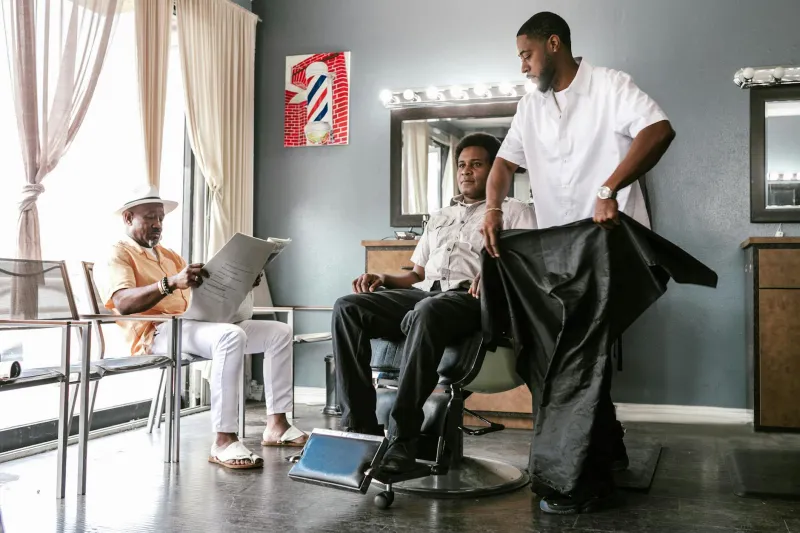
Every Tuesday at 4:30, Harold's Barbershop on Elm Street transformed into something more valuable than a place to get your hair cut. It became the nerve center of local intelligence, where three generations of men gathered not just for grooming, but for the kind of information you couldn't get from newspapers or radio broadcasts: who was hiring at the factory, which city council member was actually fighting for the new traffic light, and why the Hendersons suddenly put their house up for sale after thirty years.
 Photo: Elm Street, via www.profielaanbod.nl
 Photo: Harold's Barbershop, via cf3.ppt-online.org
This wasn't gossip. This was how American communities stayed informed about themselves.
When News Had Neighbors
For most of the 20th century, barbershops functioned as America's informal newsrooms, staffed by men who understood that the most important stories never made it into official publications. While newspapers covered national politics and world events, the barbershop specialized in hyperlocal intelligence that directly affected how you lived your daily life.
The barber himself served as both editor and archivist, collecting fragments of information from each customer and weaving them into a comprehensive picture of neighborhood life. He knew which businesses were struggling before the "For Lease" signs appeared. He heard about job openings weeks before they were posted. He understood family dynamics, business partnerships, and community tensions with the precision of a seasoned journalist — because his customers trusted him with details they'd never share with strangers.
Regular customers contributed their own pieces of the puzzle. The mail carrier shared observations from his route. The bank manager offered insights about local business health. The school principal provided updates on budget battles and policy changes that would affect every family in town. Together, they created a living database of community knowledge that was both current and contextual.
The Information Economy of Small Talk
What looked like casual conversation was actually a sophisticated information-sharing system. Men learned to read between the lines, understanding that when Joe mentioned his overtime hours, it meant the plant was doing well and might be hiring. When the hardware store owner seemed worried, it suggested trouble for the downtown business district. When the fire chief talked about new equipment, it meant either budget increases or serious safety concerns.
This intelligence network operated on reciprocity. You shared what you knew because you expected others to do the same. The system worked because everyone had something to contribute, whether it was insider knowledge from their workplace, observations from their neighborhood, or connections through family and friends.
The barbershop also served as a fact-checking mechanism. Rumors were tested against multiple sources before being accepted as truth. If three different customers confirmed the same story from different angles, it gained credibility. If details didn't align, the information was treated with appropriate skepticism.
Beyond Headlines to Human Impact
Unlike today's news consumption, which often feels abstract and overwhelming, barbershop intelligence was immediately relevant and actionable. Learning that the city was planning to repave your street next month meant you could plan accordingly. Hearing that the grocery store was expanding meant potential job opportunities for your teenager. Discovering that your neighbor's son made the varsity team meant congratulations were in order at Sunday church.
This hyperlocal focus created a different relationship with information. Instead of feeling bombarded by events you couldn't influence, you learned about changes you could actually respond to, opportunities you could pursue, and community developments that directly affected your family's life.
The barbershop network also provided context that traditional media couldn't offer. When a new business opened downtown, you didn't just learn its name and location — you heard about the owner's background, their family's connection to the community, and informed speculation about their chances of success based on local market conditions.
The Death of Neighborhood Intelligence
Television began the transformation by shifting focus from local to national news. Cable expanded the options but further diluted local coverage. The internet promised infinite information but delivered infinite distraction. Social media algorithms prioritized engagement over relevance, feeding users content designed to trigger emotional responses rather than inform community decisions.
As barbershops closed or transformed into modern salons with individual stations instead of communal spaces, the informal news network gradually dissolved. Shopping centers replaced downtown business districts, eliminating the natural gathering places where information flowed freely between neighbors.
The decline wasn't sudden or dramatic. It happened gradually, as men found other ways to get their hair cut and other sources for their information. But something irreplaceable was lost in the transition.
The Paradox of Infinite Information
Today's Americans have access to more information than any generation in history. We can track global events in real time, read opinions from experts worldwide, and access data on virtually any topic imaginable. Yet most of us know remarkably little about what's happening in our own communities.
We follow national political figures more closely than local school board members. We're more familiar with celebrity relationships than neighborhood business developments. We can debate international policy while remaining ignorant about city council decisions that directly affect our daily lives.
The barbershop's information network has been replaced by social media feeds that connect us with people who share our interests rather than our geography. We've gained access to like-minded communities across the globe while losing touch with the diverse perspectives of people who share our zip code.
What the Algorithm Can't Replace
Modern information systems excel at delivering content based on our preferences and behaviors. They can predict what we want to read, watch, or buy with remarkable accuracy. But they can't replicate the serendipitous discovery that happened when you overheard a conversation about something you didn't know you needed to know.
The barbershop's strength wasn't efficiency or personalization — it was comprehensiveness within a specific geographic boundary. You learned about your community not because you searched for that information, but because you were physically present in a space where that information naturally circulated.
This created a different kind of civic awareness. Men left the barbershop not just better groomed, but better informed about their role as community members. They understood local challenges, recognized opportunities for involvement, and felt connected to the collective life of their neighborhood in ways that transcended individual interests.
The Conversation That Built Community
The barbershop wasn't just an information source — it was a democracy in action. Men from different backgrounds, professions, and perspectives shared the same space and contributed to the same conversation. The bank president sat next to the factory worker, both equally invested in learning about their shared community.
This forced exposure to diverse viewpoints created a more nuanced understanding of local issues. Instead of consuming information in isolation, men encountered multiple perspectives on the same events, developing a more complete picture of community life.
Today's information landscape allows us to curate our sources, choosing content that confirms our existing beliefs and avoiding perspectives that challenge our assumptions. We've gained control over our information diet while losing the beneficial friction that came from encountering unexpected viewpoints in shared physical spaces.
The barbershop represented something we're still trying to recreate online: a place where information flowed freely, community knowledge accumulated naturally, and neighbors stayed connected to the pulse of their shared home. It was democracy at its most basic level — people talking to people about the place they all had to live in together.