The Index Card That Outlasted the Woman Who Wrote It
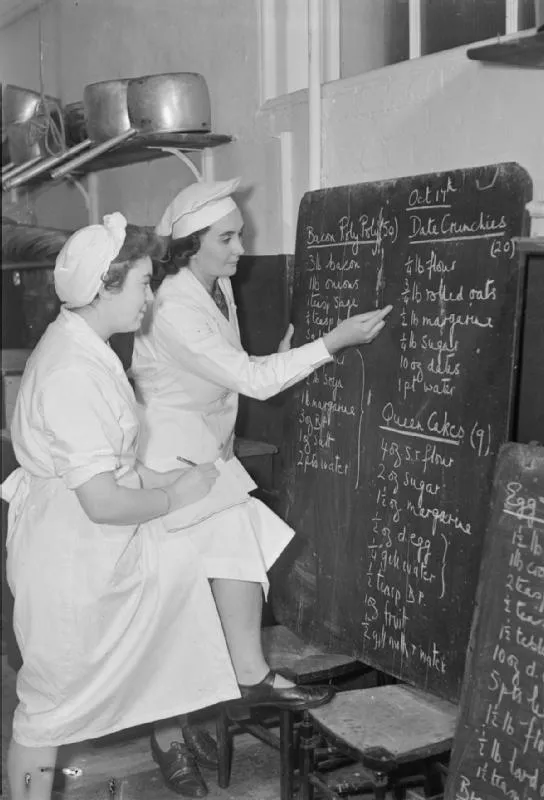
Photo: Ministry of Information Photo Division Photographer, Public domain, via Wikimedia Commons
Somewhere in America right now, there is a recipe card written in pencil, the handwriting slightly shaky because it was copied down by someone's grandmother in her seventies, passing along something she'd learned from her own mother decades before. The card is stained. One corner is burned from an incident nobody fully remembers. It has been moved through four kitchens, lost twice, and found both times at the bottom of a box that should have been thrown away.
That card is irreplaceable. Not because the recipe itself is secret — you could probably find something close to it on a food blog — but because of everything the recipe isn't: a search result, a sponsored post, a video that autoplays into something else. It's a physical object that carries a person inside it.
The Way Things Used to Get Passed Down
Practical knowledge used to travel through families the way furniture did — slowly, deliberately, with a clear sense of who it was going to next. Recipes were the most obvious example, but the transfer went much further than food. Sewing patterns handed from mother to daughter, annotated in the margins with adjustments for different body types. Home remedy notebooks filled with treatments for earaches, stomach trouble, and the particular cough that always showed up in February. Canning instructions written on the back of an envelope, the kind that assumed you already knew which berries were worth the trouble.
The knowledge itself mattered, of course. But the transfer mattered just as much. There was a moment — usually in a kitchen, sometimes at a sewing table or a workbench — where one person showed another person how something was done. Not as a formal lesson. Just as life, moving between generations the way it was supposed to.
A grandmother teaching her granddaughter to make pie crust wasn't just teaching pie crust. She was saying: this is ours, and now it's yours, and someday it'll be someone else's. That's a different kind of instruction than a YouTube tutorial, no matter how good the tutorial is.
The Cloud Doesn't Know Your Family
Today's version of inherited knowledge looks like this: something needs doing, you search for it, you find instructions, you follow them, you close the tab. The information was accurate. The result was fine. And the moment is completely gone — no trace of it left anywhere, no thread connecting you to anyone who came before.
There's nothing wrong with that, exactly. But it's worth being honest about what it isn't. It isn't inheritance. The knowledge doesn't belong to you in any lasting sense; it belongs to whoever made the video, or the website, or the algorithm that surfaced it. You borrowed it for an afternoon and gave it back without realizing you were doing so.
The result is a generation with access to more practical information than any humans in history and almost no inherited knowledge — no sense that what they know came from somewhere specific, from someone specific, and was meant for them in particular.
What the Object Carried That the Information Didn't
There's a reason people hold onto those stained index cards even when they never cook from them. The card isn't just a record of ingredients and quantities. It's proof that someone thought you were worth teaching. That they sat down and wrote something out by hand — slowly, because handwriting is slow — with the specific intention that you would someday use it.
That intention is embedded in the object in a way it simply cannot be embedded in a search result. When you find a family recipe card, you're not just finding instructions. You're finding evidence of a relationship, a moment, a decision someone made to pass something forward rather than let it stop with them.
The same was true of the handmade quilt with a note pinned to it explaining which fabrics came from which dresses. The fishing knot demonstrated on a dock on a Saturday morning, the knot-tier's hands guiding yours through the motion. The garden layout sketched on graph paper and left in a coffee can in the shed. None of these were efficient ways to transfer information. All of them were ways of transferring something more than information.
The Quiet Disappearance of Intentional Teaching
What's been lost isn't just the knowledge itself — most of it can still be found, in one form or another. What's been lost is the intentionality. The act of deciding that something was worth preserving, worth writing down, worth showing to someone younger before it disappeared.
Previous generations understood, maybe intuitively, that knowledge had to be moved on purpose or it would die. You didn't assume someone else would figure it out. You taught them. You handed them the card, or sat them down at the stove, or walked them through the steps until they had it. The transfer was an act of love, but it was also an act of responsibility — an acknowledgment that some things were worth more than one lifetime.
What Gets Lost When Nothing Gets Kept
The strange irony of the information age is that we've never had less inherited knowledge and more available information at the same time. The two things exist in inverse proportion, and it's not a coincidence. When everything can be looked up, nothing needs to be passed down. When instructions are everywhere, the act of teaching feels less urgent.
But what floats in the cloud belongs to no one. It has no grandmother's handwriting in the margins. It has no burn mark from a kitchen fire in 1971. It carries no one's voice, no one's particular way of doing things, no one's decision that this was worth saving for the people who came after.
The index card that outlasted the woman who wrote it is still out there, in someone's kitchen drawer. The question is whether anyone will think to keep it.